Lettrism and Rephonization
I first encountered Lettrism not through a manifesto or a critical text but through listening. About three years ago, I experienced Tambours du jugement premier (1952) directed by François Dufrêne as an “imaginary” sound film without image. What struck me immediately was how little there was to follow in a conventional sense. There were no stable words to track and no narrative to rely on. Conceived as a film without screen or projection, the work abandons the image altogether and places its entire weight on sound, inviting the listener not to perceive passively but to imagine or recreate what is absent. That experience became my entry point into Lettrism.
Lettrism is an avant-garde movement founded in Paris in the mid-1940s by Isidore Isou (see Figure 1) and Gabriel Pomerand. At its core is the idea that art could be radically reduced to its material components. In Introduction à une nouvelle poésie et à une nouvelle musique, Isou describes poetic history as a process of progressive condensation from the poem to the phrase, from the phrase to the word, from the word to the phoneme, and finally to the letter (Isou, 1947). Once meaning is removed, the letter remains, valued not for what it signifies, but for how it sounds and how it appears.
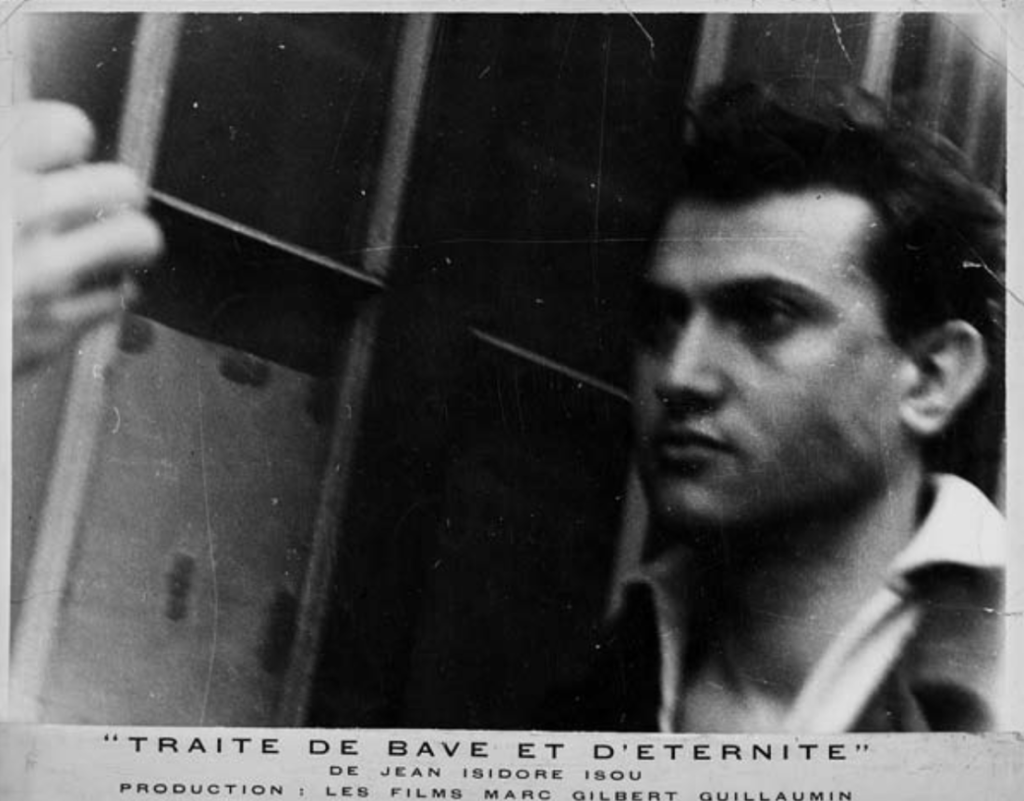
Figure 1. Press photograph for Isidore Isou’s film Traité de bave et d’éternité, 1951.
What I find important here is that reduction is not simply destructive. It is not about silence or absence. It is about shifting attention. When meaning is no longer the goal, sound does not disappear. It takes on a different role. Of course, Lettrism did not emerge in isolation. Earlier experiments with sound, noise, and non-semantic vocalization had already appeared in Dada and futurist practices, especially in the sound poems of Hugo Ball, Raoul Hausmann, and Kurt Schwitters, as well as in Antonin Artaud’s work with glossolalia and the voice as a bodily force (Kahn, 1999). Lettrism pushed this trajectory further by explicitly rejecting words altogether and treating sound itself as poetic material. It later intersected with Situationist practices through figures like Gil J. Wolman who carried Lettrist strategies beyond.
There was also a strong historical motivation behind this move. For Isou and his contemporaries, words had been worn down, compromised by repetition. Language no longer felt as language. The letter, without semantics, offered a way to start again. This position was publicly announced in January 1946 during the movement’s first manifestation in Paris, and later formalized in the manifesto published in La Dictature lettriste (Home, 1991). As Jean-Paul Curtay points out, lettrism was not only a poetic program, but an attempt to reorganize the relations between sound, writing, and image across artistic practices (Curtay, 1985).
François Dufrêne joined the group at the end of 1946 and famously declared that “poetry is a shout.” I keep returning to that sentence as it captures something essential about the lettrist attitude toward sound. Poésie was no longer something to be read or decoded, but something to be produced physically, through the voice and the body. Letters and phonemes were still there, but they no longer operated within a stable system of meaning.
Most discussions of lettrism emphasize reduction in fewer words, fewer meanings, smaller units. I want to approach it slightly differently. Rather than focusing on what is removed, I am interested in what remains when linguistic function is suspended. When sound no longer needs to signify, it does not disappear but it changes status.
Rephonization
Listening to lettrist sound poetry, I ask the question: do sound poems encode information, and do they have to?
If we approach these works with expectations borrowed from language, the answer appears to be no. There is no message to decode, no concept to retrieve. But this absence already assumes that sound must function as a sign. Lettrist practice calls that assumption into question. By rephonization, I mean the process through which sound is released from its phonological and semiotic function and re-emerges as a pure phonetic event. This is not a matter of reorganizing phonemic inventory or creating new abstract categories. Rephonization operates only at the level of the phone: articulation, airflow, friction, and duration.
Lettrist sound poetry does not erase the phonological system from which it emerges. The sounds clearly originate in the French language. But they are pushed beyond its inventory as a system of contrasts. What remains are not phonemes in the strict sense, but vocal gestures that exceeds minimal effort for phonemic function. In this sense, lettrist works propose a process for deconstruction of phonemes without a phonological motivation. Phonemes lose their status as minimal units of distinction and persist only as phones. What becomes central is the physical act of producing sound and articulatory phonetics.
This shift becomes clearer when considered alongside Saussure’s theory of the linguistic sign. In Course in General Linguistics, Saussure defines the sign as a relation between a signifier and a signified concept. Sound functions linguistically only as it participates in this relation. The arbitrariness of the sign allows meaning to emerge, but it also binds sound to representation. Rephonization suspends this relation. The signifier remains audible, but the signified is deliberately absent. Sound continues to be produced, but it no longer refers. In this sense, rephonization does not negate Saussure’s model. It operates by withdrawing one of its components and observing what happens to the other. What emerges is not noise, but a different kind of structure. Instead of being organized through contrast and reference, as in language, phonetic events take shape through time, shifts in intensity, and the physical effort of articulation. Structure is no longer symbolic, but temporal and bodily. A fricative matters not because it distinguishes lexical items, but because it sustains turbulence. A vowel-like resonance matters not because it belongs to a category, but because it appears, shifts, and dissolves. Thus, this point of view creates a purely phonetic event.
Rephonization is therefore not a return to a pre-linguistic state. It is a post-semiotic condition in which sound remains linguistic in its origin, but no longer semiotic in its function. Sound poems do not fail to encode information. They operate in a space where encoding is no longer the primary task. If sound poems do not encode information, they can instead be understood as sequences of gestures rather than as symbolic structures. What comes to the foreground is not what sound represents, but how it is produced. Rephonization names this shift in attention, away from symbolic units and toward articulatory action. In this framework, sound is not treated as a carrier of meaning, but as a trace of bodily activity unfolding over time.
To make this visible, I used Praat, a widely known tool for phonetic analysis and acoustic visualization (Boersma & Weenink, 2024). Here, Praat is not used to identify phonemes or to annotate linguistic categories. Instead, it functions as a way of extending listening by visualizing acoustic behavior over time.
The Praat view of a poésie sonore by Isou‘Recherches pour un Poème en Prose Pure’ makes visible what is difficult to describe through listening alone. What appears here is not phonological structure, but a set of phonetic behaviors unfolding over time.
As you can see in Figure 2, the spectrogram is dominated by broadband energy rather than stable harmonic bands. Instead of clear horizontal lines associated with voiced speech, we see diffuse, vertically textured regions that extend across frequency ranges. This visual texture suggests stops, friction and airflow rather than vowel resonance. Sound persists, but it does not stabilize into recognizable phonemic identities.
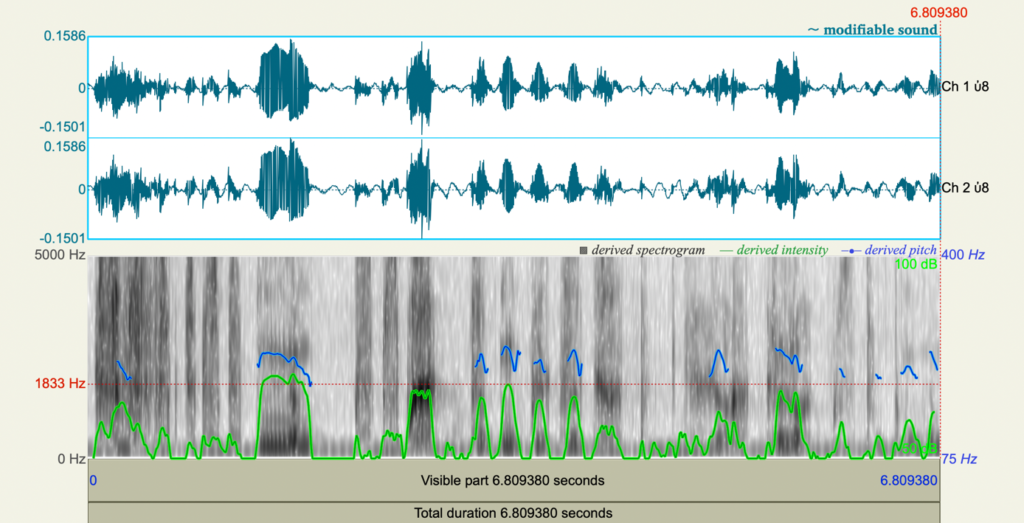
Figure 2. Praat spectrogram visualization of Recherches pour un Poème en Prose Pure.
Pitch tracking, shown in blue, appears intermittently and often breaks down. These interruptions are not analytical failures. On the contrary, they mark moments where voicing becomes unstable or collapses altogether. Sound continues even when pitch cannot be reliably extracted, indicating that phonation is no longer the organizing principle of the signal. What remains audible is friction, breath, and pressure rather than periodic vibration.
Intensity, shown in green, fluctuates independently of pitch. Peaks in intensity do not consistently align with moments of stable voicing. Instead, they reflect shifts in articulatory effort. Energy rises and falls as the body engages more forcefully with sound production, not as part of a prosodic system, but as physical exertion. Intensity here functions as effort.
My attempts to segment this material into units(TextGrids) quickly run into difficulty. Boundaries are blurred, and transitions are gradual rather than categorical. This resistance to clear boundary placement is central to my idea of rephonization. Sound unfolds as a continuous event rather than as a sequence of identifiable units.
What this Praat view ultimately shows is not the absence of structure, but the presence of a different kind of structure. Instead of phonemes organized by contrast and reference, we see phonetic events organized by duration, instability, and articulation effort. Rephonization does not eliminate sound categories by replacing them with noise. It suspends their function and allows sound to persist as gesture.
Alongside this, I include a second Praat visualization drawn from a sound segment in Venom and Eternity (Figure 3). I do not analyze this image in the same way. Instead, I leave it open. Placed next to the previous visualization, it invites attention rather than explanation.This choice is deliberate. If rephonization shifts sound away from symbolic function and toward gesture, then not every visualization needs to be resolved into analysis.
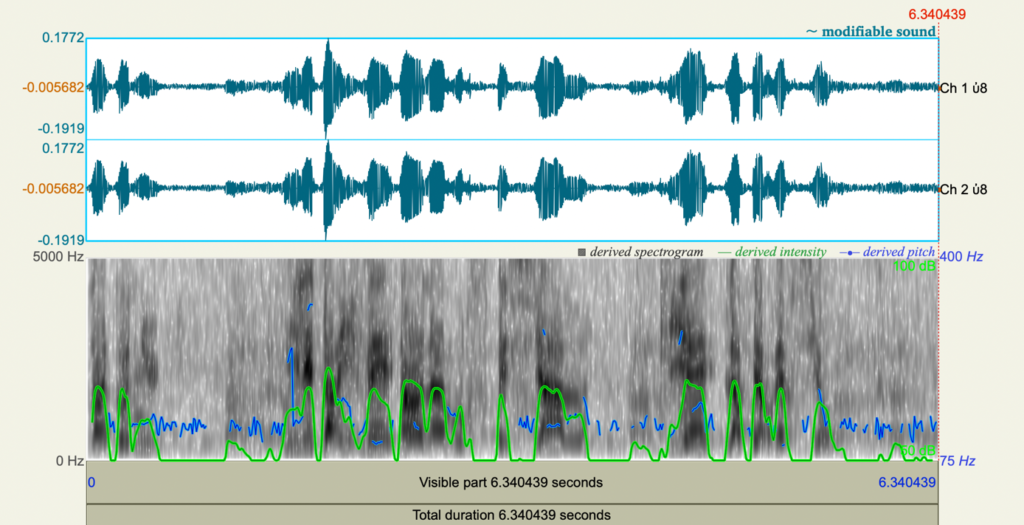
Figure 3. Praat visualization of a French speech extract from Isidore Isou’s film Venom and Eternity (1951).
To push this listening further, I want to end by pointing toward François Dufrêne’s Crirythmes (see Figure 4). Often described as ultra-lettrist, these works take the logic traced here to an extreme. Consonantal material is exaggerated, stretched and intensified to the point where articulation itself becomes almost unrecognizable. Friction, constriction, and vocal strain dominate while anything resembling stable phonological organization collapses almost immediately. Here, sound survives only as articulation.
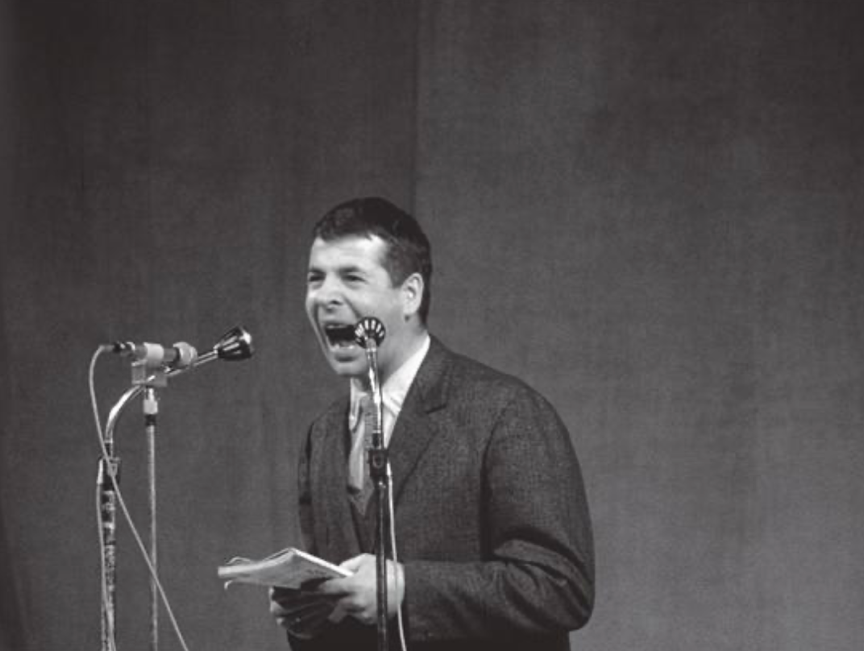
Figure 4. François Dufrêne performing his crirythme in the recital La poésie lettriste, Théâtre Odéon, Paris, February 18, 1964.
References
Boersma, P., & Weenink, D. (2024). Praat: Doing phonetics by computer (Version 6.x) [Computer program]. https://www.praat.org
Curtay, J.-P. (1985). Letterism and hypergraphics: The unknown avant-garde, 1945–1985. Franklin Furnace.
Home, S. (1991). The assault on culture: Utopian currents from lettrisme to class war (2nd ed.). AK Press.
Isou, I. (1947). Introduction à une nouvelle poésie et à une nouvelle musique. Gallimard.
Kahn, D. (1999). Noise, water, meat: A history of sound in the arts. MIT Press.
Berkay Bostan, some rights reserved.